
A Family Divided: The Lives of Francis Grosvenor and Lucy Ellen Forbis

One man’s decision in 1922 would ripple through generations. When Francis Jowett Grosvenor left his wife and three children in Saint Paul, Minnesota, he did more than end a marriage — he fractured a family. In the years that followed, he would reinvent himself under a new name, building a second life while the first one struggled on without him. The consequences of that choice would echo through his children’s lives in ways no one could have foreseen.
The first two decades of the twentieth century were marked by rapid change. America was urbanizing, industry was reshaping daily life, and families moved frequently in search of work and stability. The story of Francis Jowett Grosvenor and Lucy Ellen Forbis unfolds against that backdrop of motion and uncertainty. Their lives would carry them from Massachusetts to Texas to Missouri to Minnesota and Michigan, a restless geography that mirrors the instability of their marriage.
Francis Jowett Grosvenor: Early Life
Francis Jowett Grosvenor was born November 17, 1887, in Andover, Massachusetts, to James Grosvenor Jr. and Mary Alice Jowett. By 1900, he was living in Dallas, Texas, with his mother, stepfather James D. Langton, and sister Harriet. His stepfather worked as a piano tuner, a trade that would echo throughout Francis’s working life.
In 1908, Francis briefly enlisted in the Pennsylvania National Guard in Philadelphia. His enlistment record describes him as 21 years old, 5 feet 7 inches tall, 146 pounds, with dark complexion, grey eyes, and brown hair. His service lasted less than six months. The record notes only that he “moved from city.” It would become a pattern.
By 1910, the family had relocated to Kansas City, Missouri. Over the next decade, Francis cycled through a succession of jobs: house painter, elevator operator, packer, piano finisher, driver, victrola mechanic. He returned repeatedly to the piano and phonograph trades, industries themselves transforming as recorded sound reshaped American entertainment. His employment history suggests a man navigating instability rather than building permanence.
One curious note was added to his 1917 World War I draft registration, stating he “can’t stand heat.” Whether medical or personal, it is one of the few glimpses of personality the record preserves.

He does not appear to have served in active wartime duty.
Lucy Ellen Forbis: Early Life
Lucy Ellen Forbis was born December 21, 1893, in Dresden, Pettis County, Missouri. By 1900, her family was living in Sedalia, Missouri, where her father worked as a carpenter.
By 1910, the Forbis family had moved to Kansas City. Sixteen-year-old Lucy, who went by Ellen, was working as a bookbinder in a print office. For working-class families of the era, this was not unusual; older children’s wages often contributed to household survival.
Marriage, Family Life, and Separation
Francis and Lucy married on January 5, 1912, in Jackson County, Missouri. He was 24. She was 18.
Their early married life in Kansas City was marked by frequent moves, a series of rented houses typical of working-class urban families. During these years, three children were born:
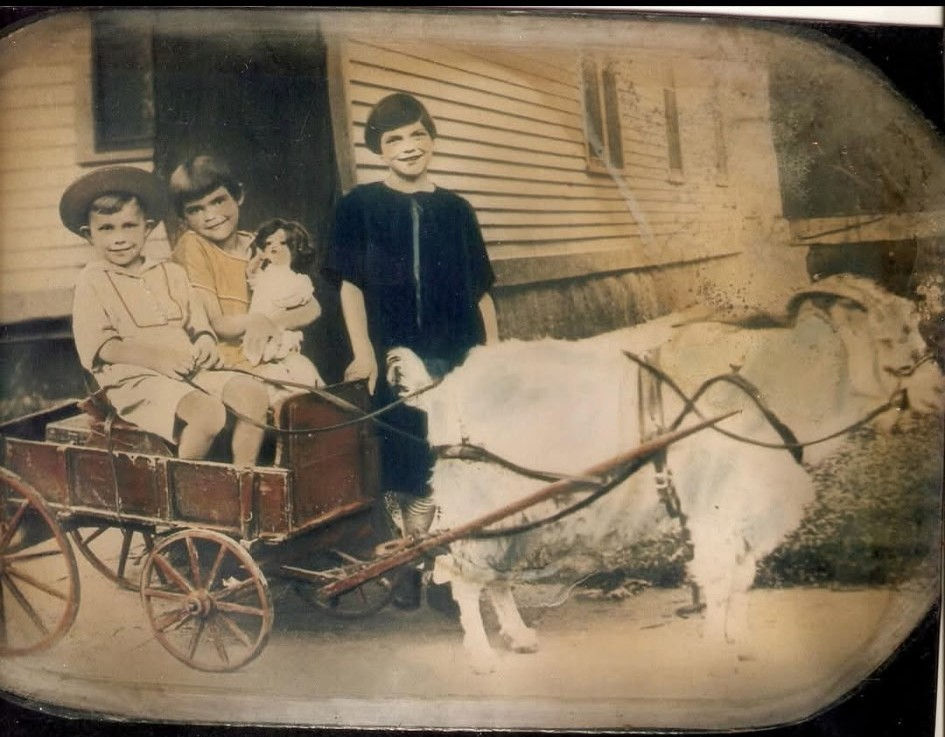
Mary Frances (1913)
Helen Florence (1916)
Eugene Russell (1918)
The youngest arrived during the catastrophic influenza pandemic of 1918.
By 1920, the family had relocated to Saint Paul, Minnesota, where Francis worked as a victrola repairman. They rented a home on Winter Street in a bustling industrial city shaped by railroads and manufacturing.
That promise of stability did not hold.
On June 1, 1922, Francis left.
Family memory preserves the moment with painful clarity: Lucy reportedly threw him out. He returned days later and asked if his girlfriend could stay in the house.
Lucy filed for divorce on August 31, 1925, in Ramsey County, Minnesota, alleging willful desertion. Francis could not be located. The court ordered the summons published in a local newspaper, a common but time-consuming method when a spouse had disappeared.
The case appears to have stalled for several years before being revived in 1929, perhaps prompted by Lucy’s new relationship and the birth of another child. On March 19, 1929, nearly four years after filing, the divorce was finally granted by default. Lucy received full custody of the children.
Francis After the Separation
After leaving Saint Paul, Francis briefly reappeared in Kansas City in 1922, and then vanished from records under his own name.
By 1930, he had resurfaced in Detroit, Michigan, as Frederick Brown, living with and claiming to be married to Sopha Seubert, a woman seventeen years his junior. No marriage record has been located. Because his divorce from Lucy was not finalized until March 1929, any earlier marriage would not have been lawful.
Under his new identity, he established a steadier working life than he ever had before. From 1930 through at least 1950, he worked as a finisher at Michigan Bell Telephone Company, earning a solid working-class income even during the Great Depression.
In 1942, his World War II draft registration card, filed as Fred Jowett Brown, listed him in Detroit, 5 feet 6½ inches tall, 145 pounds, with blue eyes and gray hair.

In his final years, Francis and Sopha returned to Kansas City. He died December 3, 1960, of heart disease complicated by emphysema and asthma. His obituary, published under the name Fred Jowett Brown, listed his wife, Sopha, as well as the children he had left behind in Saint Paul.
Lucy After the Separation
Lucy faced the years after 1922 as a single mother of three. Her divorce complaint states plainly that she worked to support herself and her children, aided at times by charitable sources.
At some point after 1922, Lucy began a relationship with Olaf Hanson, a Norwegian immigrant and Spanish-American War veteran who worked as a janitor. Their son Kenneth was born in April 1928, nearly a year before Lucy’s divorce from Francis was finalized in March 1929, a circumstance that would have carried social stigma at the time. Their daughter Faye was born in August 1929, several months after the divorce was granted.
By 1930, the blended Hanson household was established in Saint Paul.
The Depression years were difficult. In 1939, Olaf worked only thirteen weeks, earning $180 for the year. The household survived through persistence and shared effort.
Lucy died December 2, 1968, in Saint Paul at age 74. She had lived in the city for nearly half a century. She is buried at Fort Snelling National Cemetery alongside Olaf.
The Children
Mary Frances Grosvenor (1913–1963)
The eldest child, Mary Frances, grew up in Saint Paul during the Depression. She married William Johnson around 1934 and had six children with him; they divorced. She later married David Thelin around 1960; that marriage ended in divorce in October 1962.

On February 25, 1963, Mary Frances, by then 49 years old and living temporarily with her mother and stepfather, went to the apartment of her ex-husband David Thelin to retrieve a pair of glasses. Her mother Lucy was waiting for her in a car nearby. Mary Frances did not return. Thelin later called the police and admitted to striking her with a rock and strangling her. She was found dead on the bed in his apartment. An autopsy confirmed the cause of death as strangulation. Thelin was charged with first-degree manslaughter.
She is buried at Elmhurst Cemetery in Saint Paul.

Helen Florence Grosvenor (1916–2000)
Helen, my great-grandmother, married at 18 and had a large family. She lived to age 83, leaving behind dozens of descendants, children, grandchildren, and great-grandchildren.
Of Francis and Lucy’s three children, she lived the longest and left the widest generational footprint.
Eugene Russell Grosvenor (1918–1980)
Eugene was four years old when his father left. He served in the U.S. Army during World War II, attaining the rank of Technician Fourth Grade. He married, raised a family, and is buried at Fort Snelling National Cemetery, not far from his mother.

Kenneth Olaf Hanson (1928–1934)
Kenneth was the first child of Lucy and Olaf Hanson. He would live exactly six years, dying on the very day he was born, April 7, 1934, in one of the most heartbreaking accidents imaginable.
Kenneth's sixth birthday was to have been a celebration. A cake stood on the table at home. Presents lay unopened. Guests were expected. An hour before the party, Olaf took Kenneth and his four-year-old sister Faye to a nearby candy store as a birthday treat. As they stood waiting for traffic to pass at the corner of Central and Western Avenues, Kenneth broke away from his father and dashed into the street. He ran into the rear of a passing truck and was pulled under a wheel. He died in an ambulance on the way to the hospital. It was recorded as St. Paul's nineteenth traffic fatality of 1934.
Kenneth is buried at Elmhurst Cemetery in Saint Paul.

Faye Eleanor Hanson (1929–2008)
Faye was just four years old when she stood beside her father at that street corner on Kenneth's birthday.
She survived into adulthood, worked in manufacturing, married, and raised a family. She was the last surviving child of Lucy and Olaf.
Closing Reflections
Every family carries stories like this: stories of resilience, heartbreak, reinvention, and survival. They are not always tidy. They are not always comfortable. But they are real, and they shape the generations that follow.
Piecing together the life of Francis and Lucy required patience, records scattered across states, and a willingness to sit with difficult truths. Yet it is in that careful reconstruction that the past becomes human again.
If you have ever wondered about the unfinished chapters in your own family’s history, know that those stories can be found. Sometimes they are waiting quietly in court files, census pages, and forgotten newspaper columns, ready to be brought back into the light.
Full list of sources available upon request.

You do amazing work!!!!!!!👍